
NGĀI TAHU REDUX
The Little Tribe that Could…and Still Can!

Before I begin in earnest, I emphasise that I have absolutely no objection in principle to pragmatic Crown compensation for Māori groups who have suffered historic land confiscations, or unconscionable or breached land deals. Furthermore, I have no problem with anyone claiming Ngāi Tahu or any other Māori ancestry.
Moving right along…believe it or not, I have a couple of friends (possibly even more!). One of my friends - Friend#2 - claims Ngāi Tahu ancestry. More on Friend#2 later.
Friend#1 – who is not Ngāi Tahu - flicked me the following text of gratitude (and ostensible nervousness!?) following a social evening.
Thanks for a superbly entertaining evening and a further entertaining Substack kick off…fascinated with the work on Ngāi Kahu [Friend#1 means “Kai Tahu”, an alternative to “Ngāi Tahu], as they would have it. I am nervous that your part Rakiura is not quite right. The suggested view that iwi were not occupying Rakiura is highly contestable to two reasons. 1. It has traditionally been a primary source of TiTi (Mutton Birds) and photographic evidence in the museum suggests this was occurring well before 1840. 2. Maori and Pakeha Whalers worked together seemingly harmoniously as early as the 1820s given the photographs and accounts in Oban
I have covered Ngāi Tahu in a previous Substack NGĀI TAHU - by John McLean - John’s Substack. I presume the bit of that Substack that Friend#1 said is “highly contestable” is the following:
In 2021 TNT [Te Rūnanga o Ngāi Tahu, the Ngāi Tahu commercial arm] received a large area of sea off Stewart Island (Rakiura) for aquaculture, despite Ngāi Tahu never having occupied Stewart Island.
Friend#1 arguably has a valid point. By the early 19th Century some Māori who struck up relations with early non-Māori sealers, whalers and sailors on or in the vicinity of Stewart Island were quite possibly partly descended from the original Ngāi Tahu settlers of New Zealand’s South Island/Te Wai Pounamu.
Theophilus Heale, an official in the Southland provincial government, reported in 1864 (delightfully, in my view) on the legacy of these early Southern inter-racial interactions:
The original settlers are now aged men, but they are generally surrounded by half-caste families, who constitute a little community which has grown up entirely without aid or care from the government and which is remarkable for the general good conduct of its members.
Ngāi Tahu’s claimed tribal dominion over all but the very top of the South Island is, however, tenuous. This is because Ngāi Tahu were Johnny-Come-Latelys to the South Island. Distinct prior Maori populations existed in the South Island, whom Ngāi Tahu never conquered.
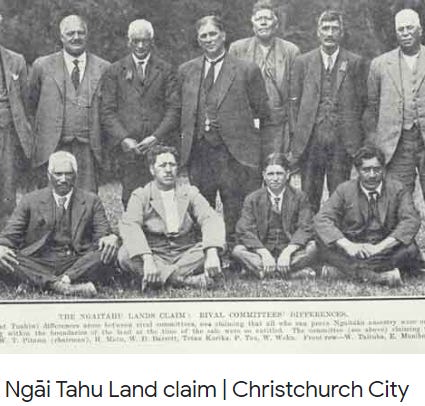
Ngāi Tahu-proper departed from around Gisborne (in the North Island) and arrived in the South Island in the late 17th century (i.e. around 1690). Ngai Tahu was beaten to the South Island by Ngāti Māmoe, a tribe from around Hastings in the North Island. Ngāti Māmoe got to the South Island at least a century earlier than Ngāi Tahu.
Ngāi Tahu and Ngāti Māmoe initially scuffled in the South Island but ended up getting on quite well by Māori inter-tribal standards. Ngāi Tahu never conquered Ngāti Māmoe and according to the Waitangi Tribunal’s 1991 on Ngāi Tahu, many Ngāi Tahu have Ngāti Māmoe links in their whakapapa and, in the far south of the South Island especially "... southern Māori still think of themselves as Ngāi Tahu-Ngati Mamoe, a synthesis of the two tribal groups ...."
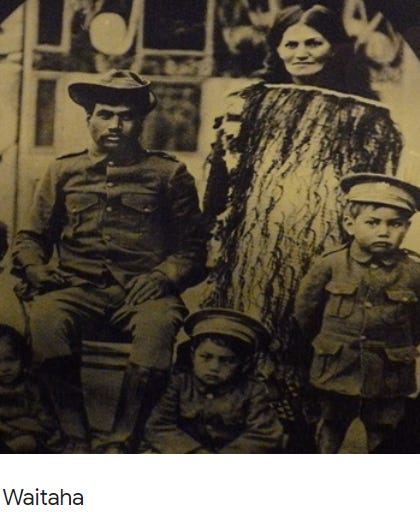
But the story of Maori occupation of the South Island certainly doesn’t start or finish with Ngāi Tahu and Ngāti Māmoe. Both tribes acknowledge that there were Maori in the South Island long before Ngāti Māmoe arrived. They are known as the Waitaha. The origins of the Waitaha are shrouded in wonderful mystery. They are probably remnant descendants of the original “Moa Hunter” Polynesian inhabitants of the South Island. But no-one really knows.
My Friend#2, who claims Ngāi Tahu ancestry (as I say, good for him), has emailed me:
“Ōraka Aparima is my rūnanga. Hence my particular offence at your Ngāi Tahu article...”
“I think your Ngāi Tahu substack has some factual inaccuracy but also some offensive (to me) stuff. I'll send you detailed feedback when I get the chance”
Friend#2 has yet to get back to me on his alleged “some factual inaccuracy” in my earlier Ngāi Tahu Substack. Fair enough; he’s a busy man. But, me being the sort of person who puts a premium on truth, I’d be keen to hear from Friend#2 on his alleged inaccuracies in my previous Ngāi Tahu Substack.
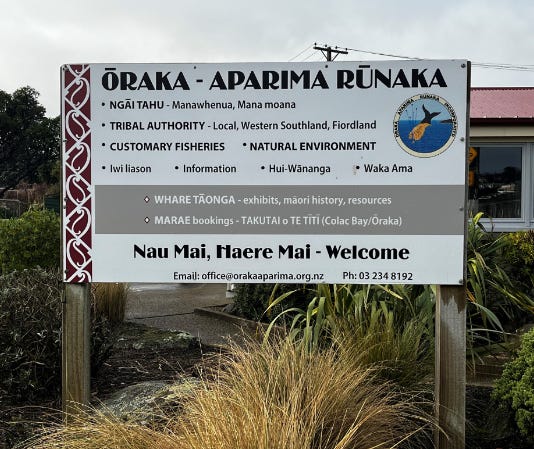
As indicated by Friend#2, his rūnanga (Maori tribal assembly point) is Ōraka Aparima, which is in Riverton, a coastal town at the Southern end of the South Island. Riverton is the oldest Pakeha settlement in Southland. Given the location, my hot reckon is that Friend#2’s Maori ancestors are far more likely to be predominantly Ngāti Māmoe (and possibly even Waitaha!) than Ngāi Tahu.
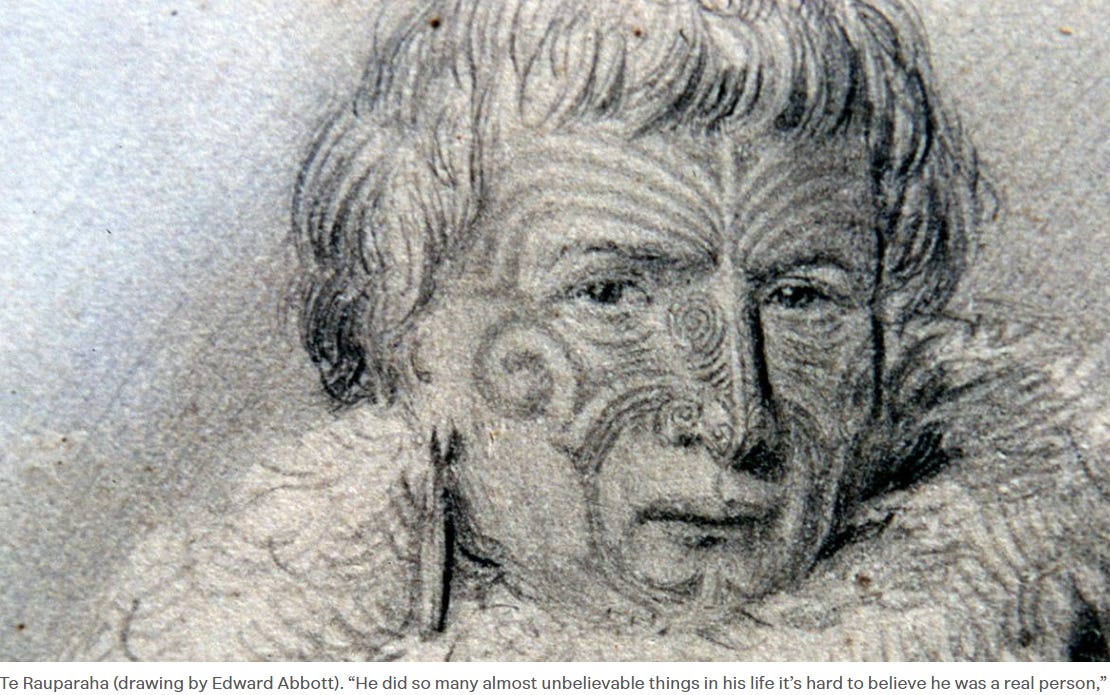
But it’s reasonable, and let’s accept, that “Ngāi Tahu” is nowadays a convenient catch-all label – arbitrarily derived from the name of a particular Maori group - for all individuals with Maori ancestors situated in the South Island in 1840, except Ngati Toa – Te Rauparaha’s outfit - who occupied the top bit of the South Island.
None of this is intended to denigrate, or ought to be offensive to, anyone with “Ngāi Tahu” ancestry. For those suitably inclined, Ngāi Tahu’s story is certainly intriguing.
What irks me, however, is the sheer volume of self-serving fabrication and obfuscation woven into the unimpeachable “official” Ngāi Tahu story.
Perhaps nothing exemplifies this official nonsense better than Ngāi Tahu’s professions about Aoraki/Mount Cook (the highest mountain peak in New Zealand), and what Ngāi Tahu acolytes say about Ngāi Tahu’s mystic connection with that mountain.
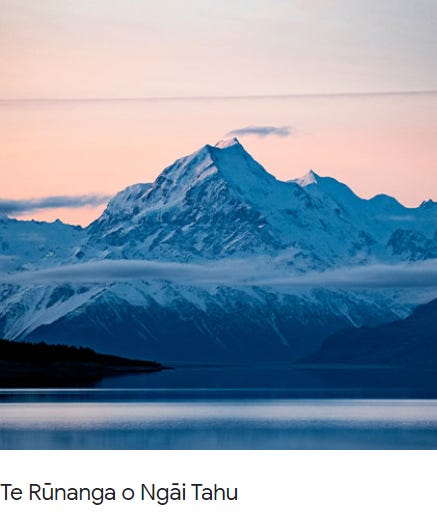
According to the Department of Conservation’s website on Aoraki/Mount Cook, “To Ngāi Tahu, Aoraki represents the most sacred of ancestors, from whom Ngāi Tahu descend”. Of course, no sensible Ngāi Tahite really thinks or wants to believe that absurdity, and the claim that a group of humans are descended from a mountain is sheer, rock-solid…voodoo.
Without modern technology, pre-colonisation Māori didn’t know that Aoraki is the highest mountain in New Zealand and attached little more significance to it than any other high South Island mountain.
Meanwhile, the Ngāi Tahu freight train rumbles on. Ngāi Tahu plays the colonisation victimhood game more effectively than any other Māori tribe. And lest we forget, the combined population of Ngāi Tahu/Ngāti Māmoe/Waitaha when the Treaty of Waitangi was signed was about 400 individuals, out of an overall Maori population of about 100,000 (the vast majority in the Northern North Island).
In its latest shakedown, Ngāi Tahu has extorted about $100 million from Genesis and Meridian in return for promising not to object to the renewal of those electricity companies’ resource consents to operate their existing dams on the Waitaki River. Genesis and Meridian are both majority owned by the New Zealand Government.
In light of Friend#1’s off-beam reference to “Ngai Kahu”, I Google searched “Ngai Kahu”. My search revealed an iwi tribe known as “Ngāti Kahu”, based around Coopers Beach in the far North of Te Ika-a-Maui (North Island) - as it happens not far from where my brother lives. Ngāti Kahu was dispossessed of large land and sea dominions but appear never to have received a dime from the Crown. Which seems grossly unfair to me. In truth, Crown compensation for Maori groups is an arbitrary lottery.
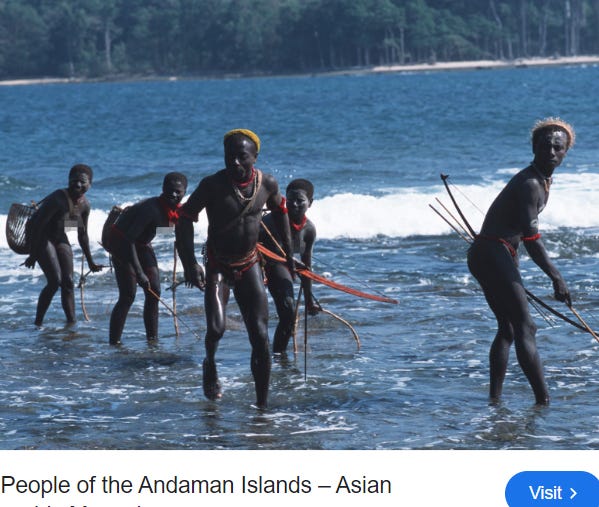
In all of this, don’t forget there aren’t any people on Earth - except perhaps a few Andaman Islanders - without ancestors who haven’t been slaughtered or driven off their land in the last 500 years. There’s nothing new under the sun, in Aotearoa New Zealand or anywhere else.
Isn’t honest, historical truth far more interesting and moving than manufactured myths?
There is whole story John about the settlements that Ngai Tahu have had and how they have quickly evolved a new set of demands and then achieved a new settlement again and again. The story of Frank Winter is also worthy of exploring. He was the leader during most of the1960's and yet he doesn't appear at all in the official Ngai Tahu history- very strange.
They are crafty people, not inclined to let the truth get in the way of a good story. Human nature I guess, good luck to them. Hard to believe that two big power companies coughed up $100 million to avoid an argument, under Labour I imagine?
A very interesting read, keep up the good work thanks.