
NGĀI TAHU
The Tribe, the Tripe, Tā Tipene…the Myth, the Legend

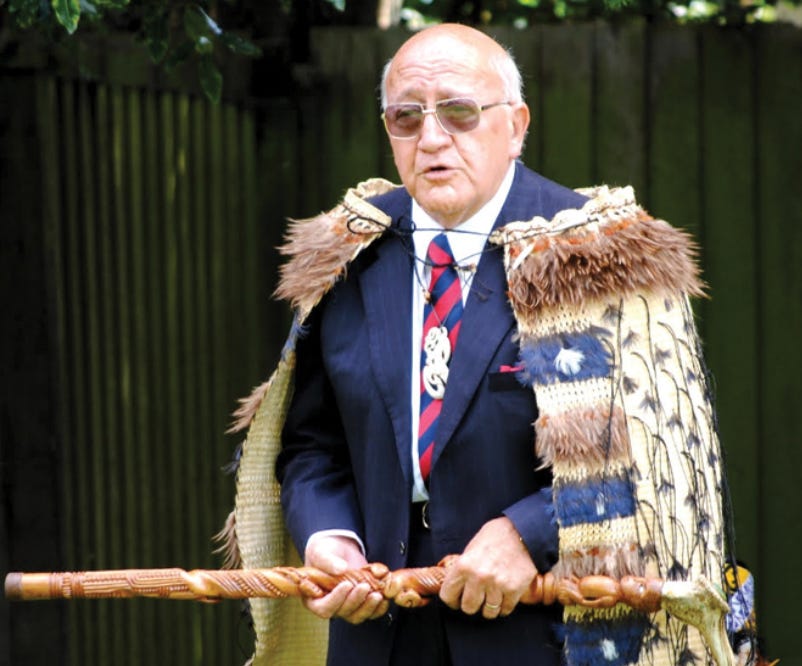
Ngāi Tahu, the juggernaut Māori tribe, is – to put it plainly and without meaning to be mean – essentially bogus.
Ngāi Tahu’s explosive tribal authority, Te Rūnanga o Ngāi Tahu (“TNT” - see what I did there), has enjoyed colossal commercial successes since Ngāi Tahu’s settlements with the Crown. Those settlements are based a notion that the Crown deprived Ngāi Tahu of dominion over an asserted Ngāi Tahu territory – being all of the South Island, including Stewart Island, except a relatively small area north of the White Bluffs Southeast of Blenheim and Kahurangi Point inland from Nelson. And yet that notion is patently false and easily debunkable. The official Ngāi Tahu backstory is myth.
Ngāi Tahu’s mythmaker and orchestrator is Sir Stephen Gerard O’Regan, now known mainly as Tā Tipene O’Regan.
Ngāi Tahu originated in the Gisborne District of the North Island of New Zealand and ventured to the South Island in the later part of the 17th century. To put this in historical perspective, the Dutch explorer Abel Tasman visited the South Island well before Ngāi Tahu arrived there.
Ngāi Tahu are said to have absorbed other Māori who were already in the South Island when Ngāi Tahu arrived. In fact, “Ngāi Tahu” is best regarded as simply a convenient label to put on Māori who resided in Ngāi Tahu Territory around the time of the Treaty of Waitangi.
Before Europeans arrived in New Zealand, the Māori population was about 100,000, with very few Māori – about 600-800 individuals – in the South Island, about half of whom inhabited the top part of the South Island, outside of Ngāi Tahu Territory, and who were certainly not Ngāi Tahu; they were Ngāti Toa (Te Rauparaha’s mob). So, Ngāi Tahu’s population on European colonisation was at most about 400 i.e., about 0.4% of the overall Māori population. That’s on average about one individual Ngāi Tahite per 400 square kilometers.
But my goodness how Ngāi Tahites have multiplied in the last 250 years. The number currently registered with TNT as Ngāi Tahu is now, according to the Ngāi Tahu Tourism website, officially 70,000. Goodness knows how eligibility for Ngāi Tahu membership is determined in practice.
Ngāi Tahu would be nothing much at all without O’Regan.
Born in 1939, after Victoria University and teacher’s college O’Regan worked as a primary school teacher and then lectured at teachers’ college from 1968 to 1983. At 44, O’Regan was going nowhere much. But something had happened in 1976 that would lead eventually to his big break; in that year he come onto the Ngāi Tahu Māori Trust Board.
In 1991 the Waitangi Tribunal found that "the Crown acted unconscionably and in repeated breach of the Treaty of Waitangi" in its land dealings with the Ngāi Tahu and recommended substantial compensation. At age 52, O’Regan adroitly seized his destiny. He convened a team of fellow Ngāi Tahites, combined with legal, investment banking and other grunt, and the rest, as they say, is history – albeit a still-evolving history.
O’Regan was knighted in 1994 for services to the Māori people and the community. 2022 was an especially big year for O’Regan. He was appointed a member of the Order of New Zealand, an exclusive club limited to 20 living individuals "to recognise outstanding service to the Crown and people of New Zealand in a civil or military capacity". While O’Regan has obviously done a monumental service for Ngāi Tahu, quite what he has done for the Crown or the people of New Zealand in general is entirely unclear. Also in 2022, KiwiBank made O’Regan its “New Zealander of the Year”.
A settlement deed was signed between Ngāi Tahu and the Crown in 1996, implemented by subsequent legislation.
The first legislation was the Ngāi Tahu (Pounamu Vesting) Act 1997. This Act vested all of a certain type of jade - commonly known in New Zealand as greenstone and called “pounamu” in the Māori language – as the exclusive property of TNT. Vast amounts of a naturally occurring and extremely valuable substance are given exclusively to people who claim ancestral connection to a small group of people who just happened to be physically located in the South Island about 200 years ago.
But the Pounamu Vesting Act was a mere firecracker compared to the settlement atomic bomb of the Ngāi Tahu Claims Settlement Act 1998. Under that Act, vast commercial property, farm and forestry land and fisheries resources are vested in TNT in settlement of claims associated with “purchases of Ngāi Tahu land”. Because there were no Crown confiscations of land in Ngāi Tahu Territory, Ngāi Tahu has been vastly compensated for land that Ngāi Tahu willingly sold to the Crown.
There were also whopping dollops of fishing quota received by Ngāi Tahu as its share of the Crown’s 1992 settlement of Māori fisheries claims and the smell of fishy Ngāi Tahu settlements lingers. In 2021 TNT received a large area of sea off Stewart Island (Rakiura) for aquaculture, despite Ngāi Tahu never having occupied Stewart Island.
On top of Albert Einstein’s two theories of relativity, Ngāi Tahu has formulated a third.
Under the Ngāi Tahu relativity clause in the Ngāi Tahu deed of settlement, since the aggregate amounts paid out in Treaty of Waitangi settlements exceeded a billion dollars, Ngāi Tahu has received whatever further amounts it had to receive in order for its overall share of the aggregate settlement amount to be 17%. 17% is a curious percentage and it’s not clear where it came from, especially given Ngāi Tahu comprised 0.4% of the Māori pre-colonisation population.
So far, Ngāi Tahu has received over $300 million in relativity payments. It is currently in Court claiming another $18 million. With the Government yet to reach settlements with the real/populous tribes such as Nga Puhi, Ngāi Tahu’s entitlement to relativity payments from the Crown is, for all practical purposes, limitless.
Ngāi Tahu is preposterously brazen. Represented by ex-Attorney General and Minister for Treaty of Waitangi Negotiations, in 2021 Ngāi Tahu took legal action against the Government claiming “repeated failures over successive governments to protect the country's waterways" and further that "the crown must recognise their rangatiratanga — governing authority and self-determination — over waterways stretching across most of the South Island". Ngāi Tahu is claiming dominion over all South Island waterways. The claim focuses on the effects of dairy farming on water quality, despite Ngāi Tahu being an industrial scale dairy farmer in the South Island.
Ngāi Tahu’s latest coup is getting a couple of unelected Ngāi Tahu representatives onto Environment Canterbury. The rapacious Ngāi Tahu rort rolls on unabated.
Steven O'Regan is an accomplished Fabulist or Opportunist for sure. I was working at Bell Gully with Chris Findlayson when that firm acted for Ngai Tahu in their early 90s settlements. One giant Nudge Nudge Wink Wink. Can't blame Ngai Tahu though. They just sniffed the burgeoning zeitgeist/milieu and went for the money jugular.
Thanks Roger. I had read about the earlier "settlements". People like that Tirikatene, include Sir Apirana Ngata, are now of course regarded by the current "Enlightened" as just misguided Uncle Toms