
UNLIKELY DOCTOR TE MOKE
My review of a book about a medical doctor

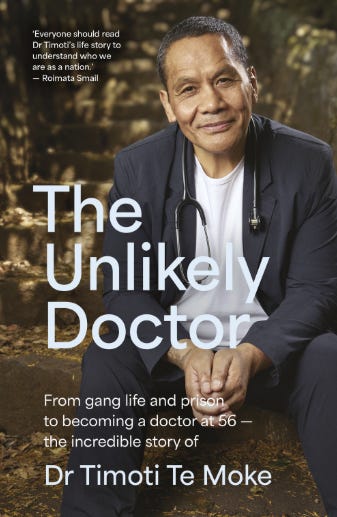
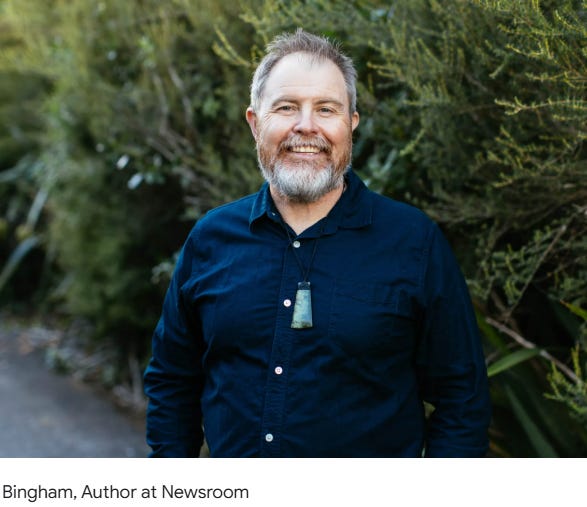
I’ve just read The Unlikely Doctor, a book about a man who now goes by the name of Timoti Te Moke. The book is written in the first person (“I”), but was in fact written for Te Moke (and the publisher, Allen & Unwin) by a fella named Eugene Bingham. Being a full time medical doctor, Te Moke made it plain, “I ain’t got the time [to write a book]”.
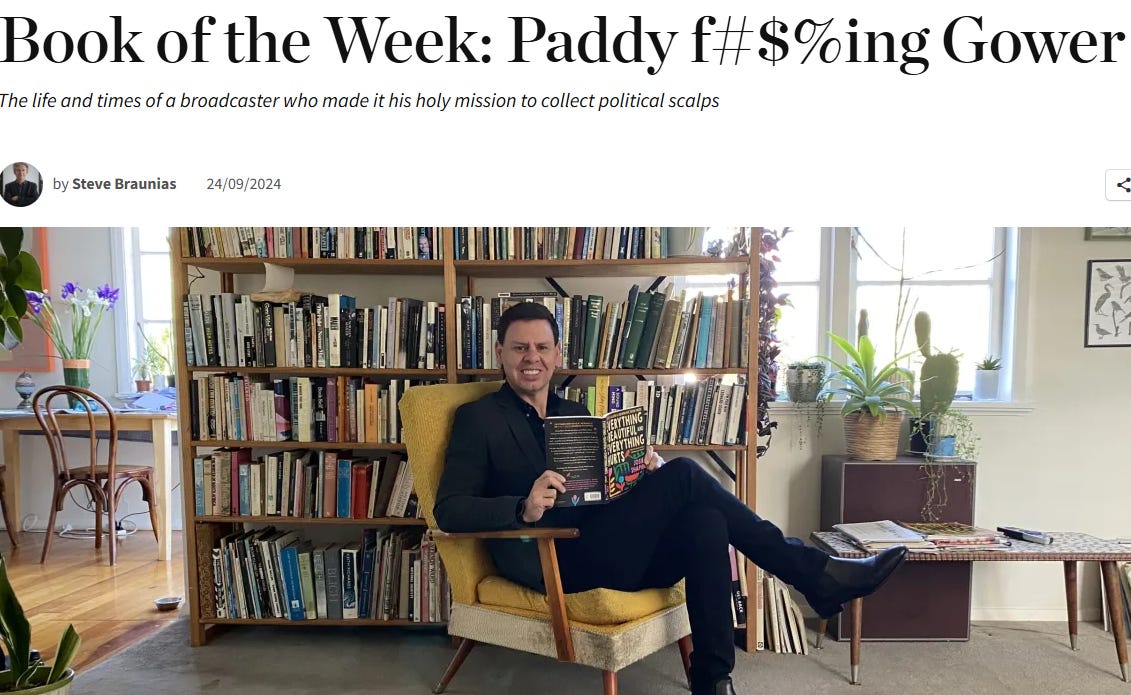
Bingham also ghostwrote the book titled This is the F#$%ing News on behalf of joke journalist Paddy Gower. As a wordsmith, Steve Braunias eats Bingham and Gower for breakfast. Braunias’ unflinching review of “Gower’s” book began…
The central problem I have with Paddy Gower’s autobiography This is the F#$%ing News is that he didn’t f#$%ing write it. There’s a laziness and a complacency to this as-told-to exercise…Gower can probably write a decent sentence. He’s, you know, a journalist. He knows his way around a keyboard. Why did he need Eugene Bingham to act as his ghostwriter? Is Bingham going to write his Stuff stories for him, too? There are just some things you don’t tell someone, even your amanuensis, and the book feels detached, phoney, a bit unreal. The unexamined life is not worth publishing.
Your Unlikely Book Reviewer has reviewed only one other book. This Substack review is one of my most read Substacks:
THE UNTOLD JACINDA

I’ve just finished reading JACINDA THE UNTOLD STORIES, “by David Cohen, with Rebecca Keillor”.
The Unlikely Doctor describes Te Moke’s gritty life to date and his indisputably remarkable and admirable achievement - given his bad luck in life - in becoming a medical doctor at age 56. But, as inspiring and moving as it is, The Unlikely Doctor is significantly flawed literature.
The incessant speech marked (“ ”) quotations of invented dialogue don’t add verisimilitude but, rather, make the reader wonder just how much of the rest of the content has been made up. And the book is blighted by deflections, minimizations and downright untruths.
The main thing downplayed in the book is the appalling role that Te Moke’s mother played in his tough start to life, and his life in general. Te Moke’s mother gave Timoki up as a toddler to her parents, where he says he was nurtured and loved. Then, when the boy was six years old, his mother demanded him back as her ticket for higher social welfare child support benefits. She hauling him back into a horrible household with a ghastly violent step-father. Mother lied to the Court that her partner was Te Moke’s biological father and formally changed the child’s name to Timothy Morrison.
Another minimization is the fact that his biological father, said to be Tongan, buggered off before Te Moke was born, never to be seen again. That’s a terrible thing to happen to any child.
Unable to honestly confront the dastardly dual causes of this descent into crime and imprisonment (his mother and absent father), Te Moke – in Bingham’s ghostwritten words - blames colonization. Quoting from the book:
“That is what we [Māori and Pasifika people] do – we become doctors and nurses and lawyers and teachers and other professionals…even though our people were colonized.”
“…but its only since the introduction of capitalistic food production that people of Aotearoa New Zealand, and my people in particular, have experienced hypertension, type 2 diabetes and renal failure. Just saying.” [How could Dr Te Moke possibly purport to know that? Average Māori life expectancy before colonization was about 27. Perhaps most Māori never got old enough to suffer hypertension, type 2 diabetes, renal failure or suchlike]
“The Māori Party had been formed in the aftermath of the Foreshore and Seabed Act, a law change that robbed iwi of rights won in court. Outrageous.” [Incorrect. Helen Clark’s legislation did not rob Māori of rights won in court. No Māori customary fishing rights had been won in Court when Harridan Helen’s legislation was passed.]
“Sometimes I think about an alternative universe…in which Māori and Pasifika don’t have to deal with the worst of the justice system – the presumptions, the racial profiling, the prosecutions, the pressure just to plead guilty – more of than anyone else has to.”
I’m a descendant of many generations of New Zealanders without Māori ancestry (i.e., I’m entirely descended from “colonizers”). And I defensively bristle at being blamed for all society’s ills and stickered with white privilege. My skin is as thin as it is pink.
Te Moke’s blaming of colonization for his personal challenges in life contrasts starkly with the attitude that my dear deceased friend, Robert Tuhekengarangi Morehu, took to his own tough life. I’ve covered this remarkable man:
ROBERT TUHEKENGARANGI MOREHU MĀTĀTOA

Robert Tuhekengarangi Morehu was born in Shannon on 9 December 1933, the first born son of Iapeta Tamahou Morehu (also known as Robert, Ngati Tuwharetoa) and Arapera Bella Morehu (known as Bella, Tainui).
Robert’s gravestone at his urupa (cemetery) bears the inscription “a self-inflicted tumultuous life”, and there’s some truth in that. (Robert’s son, also a good friend of mine, went along with the inscription!)
Robert T Morehu certainly didn’t run around blaming anything on colonization.
The book about Dr Timoti Te Moke dwells on the Central North Island (CNI) Treaty of Waitangi Settlement, in the following terms:
“The [2008 Central North Island (CNI) Forests Deed of Settlement] provided redress for iwi in the area over historical Te Tiriti o Waitangi breaches connected to land seized by the Crown for state forests – thousands and thousands of hectares. All those trees you see when you drive through the central North Island, those massive forests. Yeah, they were planted on Māori land taken by the Crown.”
That statement is completely incorrect. The CNI Settlement was not for land confiscations, or even primarily for unconscionable land dealings by the Crown. The supposed Treaty breaches behind the settlement remain largely unclear to this day. Robert Morehu confided in me that he couldn’t understand the CNI settlement, given there were no confiscations.
The blurb on the back page of Dr Te Moke’s book states “A true story of resilience, redemption and revolution”. As indicated, Timoti’s story, while certainly of resilience and redemption, is not all true. Te Moke’s recounting of faded and selective memories to ghostwriter Eugene Bingham was akin to Chinese whispers.
And blurb’s “revolution” claim is murky.
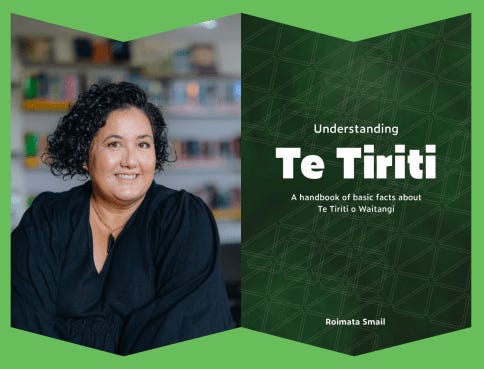
Timoti appears to have fallen into the thrall of a Māori activist lawyer, Roimata Smail. In 2024, Roimata published a book titled, Understanding Te Tiriti: A Handbook of Basic Facts About Te Tiriti o Waitangi. Roimata’s didactic handbook is decidedly short on “basic facts” but, predictably, big on the invented, ahistorical notion that there exists, as I type, an entirely separate nation of undefined “Māori”.
Back in 2019, Roimata, on Timoti’s behalf, filed a claim with the Waitangi Tribunal requesting an urgent hearing into her and Timoti’s allegations of systemic bias against Māori in the prosecution of crimes. Timoti’s claim has subsequently been rolled into a wider, undecided, Waitangi Tribunal claim alleging wholesale justice system bias against Māori.
My overriding hope is that Timoti hasn’t paid Roimata a dime of his own money, from his book proceeds or doctor’s salary or otherwise. Waitangi Tribunal claims are mainly funded by “legal aid” i.e., New Zealand taxpayers.
Apart from wanting a fairer and generally better New Zealand (who doesn’t), it’s not clear what “revolution” Dr Te Moke might have in mind. At one stage, according to the book, the good doctor advocated to disgraced Police Commissioner Andrew Coster for “an independent body that oversaw police decisions to prosecute Māori”. Coster is said to have demurred.
IMPOSTER COSTER SHIFTS INTO SURVIVAL MODE

On 1 November 2023 I attended a Free Speech Union event at Wellington’s Pipitea Marae. The theme for the “conversation” between former New Zealand Prime Minister Sir Bill English and former UK Supreme Court Justice Lord Jonathan Sumption was “A crisis of law and politics; the right to defend a tolerant culture
If the book is to be believed, Te Moke’s self-esteem is rising along with his prospects in life. The book ends with:
“So I will keep going, creating change in such a way that when it’s time for me to leave the earth, the world will know my name; the world will be a better place because I was here.”
It comes as a comfort to me that it was born-again Māori Eugene Bingham who wrote those words, and not Dr Te Moke. Because Timoti doesn’t strike me as an egomaniac. Because the big wide world will never know Timoti Te Moke’s name.
It’s just great the good doctor is now fulfilled and contributing to colonized New Zealand, in a medical profession that wouldn’t exist without colonization.
Nice write John. Boris is all for people pulling themselves up, overcoming a tough start (shitty parents deal that he had) and finding success. Good on him. But most indeedy, if the colonisation comments are really his, then he is deluded. Pre-colonisation he would simply have been an unwanted child and become the victim of intentional infanticide (one less mouth to feed). I also can't help but wonder if he got into Otago Med via the Maori-Entry pathway, which lets brown-link folk get in with 70% pass rates in first yr Health Sci. Nice that he now works as a doctor, (one hopes he now bats above 70% cos I don't like a 30% chance of my doctor being wrong), but the reality is his graduation at 56 via special entry denied some young non-brown kid from gaining entry and giving us maybe 40+ years of doctoring.
Was it Goebbels who said something to the effect that if you make a lie big enough and tell it often enough then it becomes the truth.
My other observation is an increased awareness of the reality of the expression 'no good deed goes unpunished'. I used to wonder what that actually meant and how and where it ever played out. The treaty settlement process seems to be now to be a good example. Thirty odd years ago people of my age entered into what was in effect a good faith social contract that as taxpayers we would over our working life fund a make good of impropriety by the NZ government more than a hundred years ago, especially with regard to land confiscations.
Well that good deed has not, in my view at least, been treated in good faith. We are no closer to putting these claims behind us - the taxpayer has paid out the money but remains subject to even greater allegations that it stole land. The money is not trickling down to help non elite Maori, as evidenced by elite Maori's claim that they are over represented in the worst health, education and crime statistics. Further, the willingness to engage in redress has only signalled weakness to the elites and the activists who - possibly funded by the very treaty settlement monies - now want to argue that sovereignty was never ceded, and demanding Co-governance of the country. Further, the Waitangi tribunal which was set up to operate professionally and independently is now operating well off script and has chosen to side with the activists and elites. Once again, an institution set up in good faith to provide redress for past wrongs has turned and bites the hand of the taxpayer that feeds it.