
OPPORTUNITY V. OUTCOME
Is one societal Equality more equal than the other?


To borrow from the Sesame Street jingle…One of these equalities is not like the other, which one is different, do you know? This piece is a simple refresher, and a few thoughts, on two distinctly different notions of optimal societal equality.
The debate about the relative merits of Equality of Opportunity as against Equality of Outcome is as old as the hills and, like most hills, isn’t going away any time soon. The fabric of the debate is woven with many of the philosophical threads that have engaged politicians and thinkers throughout human history.
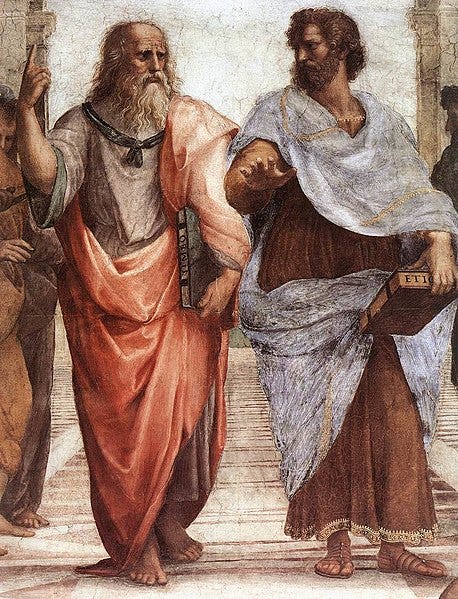
Aristotle and Plato debated the pros and cons of societal striving for economic equality among its citizens. Their debates often concerned equality – or otherwise - between biological males (men) and biological females (women) – categories that these days are flirting with official cancellation in Aotearoa New Zealand.
Socrates, on the other hand, seemed to prefer musing on an abstract “Ideal” of Equality. This was probably because his wife, who ran the roost admirably while the Bearded Sage philosophized around the traps of the Metropolis, was also a frightful nag who kept the Old Soc properly under her thumb.
Plato argued that men and women should be afforded equal opportunities to contribute to their society according to their different essential “natures”, and that females should be afforded an equal opportunity for their inherent abilities (like looking after the household) to be nurtured and put to good use within society. Plato seems to have been more about Equality of Opportunity as a means to best advance overall societal good.
What are the Two Equalities and how are they different?
Equality of Opportunity
Equality of Opportunity aspires to an ideal where individuals have a relatively equal opportunity - regardless of the circumstances into which they are born - to exploit their natural talents and better their lives. The emphasis is on educational avenues and career prospects, but not on outcomes.
For those who favour Equality of Opportunity - who for ease of reference we’ll call “Opportunists” - it’s inevitable, and doesn’t in itself matter, that societal outcomes will be unequal. Some, despite sound educational and career opportunities, do not take their opportunities and remain in Strugglesville. On the other hand, at the top of the societal ladder, many born into privilege will squander their good luck. A potent belief in human agency and freewill permeates Opportunists’ thinking.
Equality of Outcome
For those who favour his form of equality - whom we’ll call “Outcomers” - Equality of Outcome is the sought-after societal state in which all citizens enjoy roughly the same wealth and income, with everyone’s general economic position being about the same.
Perhaps the most insistent proponent of Equality of Outcome in modern political discourse was Fabian socialist, political thinker, and dramatist Bernard Shaw (1856–1950). Shaw was an unabashed apologist for Stalinist Russia and regarded Stalin’s deliberate starving on his own subjects as the equivalent of having to break of few eggs to make an omelet (in respect of which George Orwell retorted “But where is the omelet?).
For Outcomers, anything like Equality of Opportunity is unobtainable simply through education and career opportunities because of drastic differences in the circumstances into which – not to mention the genetics with which - people are born. Outcomers believe that, with all the human agency and determination available to an individual born on the wrong side of the tracks, luck still plays a whopping and unfair part in any prospect of personal betterment, and the State has a legitimate role to play in making outcomes (not just opportunities) more equitable.
And that, in a nutshell, is Outcomers’ fundamental criticism of Equality of Opportunity. (Outcomers are closer than Opportunists to admitting the plain truth that many people are born just plain stupid and useless, with no realistic prospects in life.)
So Outcomers like picking particular societal groups for State-enhanced societal opportunities and, more particularly, trying to even out economic outcomes, by way of wealth-redistribution and channeling collective societal resources in chosen directions. Outcomers favour “positive discrimination”, in education and the workplace.
The Dodo’s line to Alice in the novel Alice's Adventures in Wonderland - "everybody has won and all must have prizes" – is a not-too-subtle dig at Outcomers from author Lewis Carroll (real name, Charles Lutwidge Dodgson).
The main criticisms to be levelled at Equality of Outcome in anything other than a mild form are:
· Achievement of its objectives would necessarily require extreme and vastly expensive totalitarian Governmental control and legal prescriptions, and drastic intrusions on individual liberties
· Equality of Outcome undermines a general sense of personal agency, individual responsibility and productive personal striving. The citizen is encouraged not to grasp the sliver of life she can control and run with it but, rather, to look to a nanny State for guidance and support – and blame the State and other fellow citizens when things don’t turn out as she’d hoped
U.S. Supreme Court Bans Positive Discrimination at Universities
Which brings us nicely to what can only be described – from whichever side of the fence you sit in these matters - as the truly momentous decision recent decision of the Supreme Court of the United States in STUDENTS FOR FAIR ADMISSIONS, INC v. PRESIDENT AND FELLOWS OF HARVARD COLLEGE.
In a 6-3 decision, the Court’s six conservative justices declared that colleges’ use of race as a factor in determining student admissions is unconstitutional. They cited the US Constitution’s Fourteenth Amendment, which prohibits discrimination based on race.
As ground shifting as it is, the Supreme Court’s decision was eminently predictable.
First, the Court’s overwhelming conservative majority could easily have been expected to oppose social-engineering racial preferences.
Secondly, a majority of U.S. citizens actually oppose race-based “affirmative action”, even in “progressive” States like California. (Born-Again Wokester and Alzheimer American President Biden has nevertheless announced “We cannot let this decision be the last word.” Given the primacy of the U.S. Supreme Court decisions and Biden’s “advanced” state, it’s not remotely clear what “We” expects to be able to do about the decision.)
Thirdly, the racial affirmative action implemented by the likes of Harvard University has, from its inception in the 1960s, been a tad incoherent and internally contradictory. The races that have overwhelmingly received the preferences are exclusively people from, or with ancestors from, Sub-Saharan Africa (“Black”) or South America (“Latino”). The expressed rationale is that such groups have been under-presented at Universities – which is true. But what of, say, ethnic Russians? One justification for boosting Black applicants’ prospects of getting to College (University) has been to address what’s perceived to be the prejudicial, intergenerational legacy of slavery. The deepening wrinkle in that justification is that, especially more recently, it's recent arrivals from Africa who have ridden racial preferences into U.S. educational institutions.
But the main and intractable problem with racial preferences in education is that, for all practical purposes, it’s impossible – in an arena of finite resources – to admit individuals of a preferred race, who wouldn’t otherwise have “got in” – without knocking out individuals of non-preferred races. And that’s what has especially aggrieved industrious Asian Americans, who constantly think they have earned their College bus ticket only to be left wondering what they did to lose their seat on the bus.
Closing thoughts
All else being…as equal as it can be, a few closing thoughts…
· All debate about economic equality of any sort is academic without economic productivity. Without wealth, there can be neither economic opportunity nor any useful levelling of what wealth a nation state generates
· A bit of wealth re-distribution through a “progressive” income tax system and State provision of safety-net welfare is consistent with Equality of Opportunity, provided the objective is to enhance opportunities and not simply equalize outcomes
· There is laudable human dignity of performing economically useful work, which creates authentic personal feelings of “self-creation”. A bloated public service of vacuous jobs ultimately does no-one any real favors
· Extreme inherited wealth is a grating conceptual problem for Equality of Opportunity. Opportunists tend to defend inherited wealth, on the basis that to tax inherited wealth would reduce incentives to earn and accumulate wealth. However, it’s impossible to logically claim that large inherited wealth represents any sort of deserved opportunity for the lucky heir
· Picking underprivileged categories of citizens for preferential attention, with a view to zeroing in on Equality of Outcome, is much more difficult that one might think, in both theory and practice. For example, if Māori in Aotearoa New Zealand are regarded as a category deserving of an across-the-board leg-up (e.g., preferential entry to Medical School), how is anyone to the qualified as Māori (any Māori lineage/50% Māori ancestry/cultural affiliation) and how is qualification to be tested? Vetting regimes to select individuals for membership of preferred categories consume vast collective resources.
· Distinguishing between Equality of Opportunity and Equality of Outcome is not always easy. For example, is positive discrimination for admission of “mature” individuals as university students in pursuit of Equality of Opportunity or Equality of Outcome?
Finally, the debates between Opportunists and Outcomers may well be overly fixated on economic incomes and wealth. The more-recent concept of Equality of Autonomy focuses on spreading as widely and evenly as possible citizens’ feelings that they are choosing the courses of their lives. And indeed, isn’t it supposed to be all about feelings these days?