
MĀORI MALADIES
Why are Māori over-represented in negative stats?

I’ve recently been asked:
“What in your view are the causes of Māori being over-represented in negative stats (poverty, poor health outcomes, crime, imprisonment)?”
I should be flattered that my inquisitor apparently believes I’m qualified to answer such a complex and fraught question.
I should also start by acknowledging that I can’t - as former Prime Minister Jacinda Ardern was prone to do - “reject the premise of the question”. Māori really are negatively over-represented in some significant societal statistics.
So, let’s work through the categories of alleged over-representation, assessing the degree to which Māori are adversely over-represented, and why that might be the case.
Poverty
The best statistics I can find indicate that the average annual income for Māori in New Zealand is about $51,000, compared to about $55,000 for non-Māori.
And the median Māori income seems to be about 80% of non-Māori (Pasifika are at about 70%). (“Median” income is the income of the middle person; if there are a million Māori, the median Māori income is that of the 500,000th Māori, if Māori are ordered according to income.)
Reliable figures for wealth are even harder to find, but it does appear that Māori are on average less wealthy than non-Māori New Zealanders.
The politically acceptable answer for Māori adverse over-representation in poverty is of course…colonization of New Zealand by non-Māori. Which doesn’t much wash, because non-Māori Polynesian people (who haven’t been colonized, at least in New Zealand) are over-represented in bad stats in much the same ways and proportions as non-Māori.
Plus, there are logical, practical limitations on the notion of colonization causality. It’s quite bonkers to think that being partly descended from original inhabitants who were joined by other people over 200 years ago could, of itself, significantly affect the level of wealth (or health or criminality) of those descendants. No-one in New Zealand, or indeed on Earth, hasn’t got quite recent ancestors who haven’t been colonized.
In absolute terms, colonization has helped Māori in every category except criminality/imprisonment. Māori enjoy vastly augmented overall health and wealth as a result of colonization. Crime and imprisonment didn’t exist in their current forms in traditional Māori society. Unlike nowadays however, slavery and killing (including female infanticide) were endemic in New Zealand before colonization.
Here are my hot reckons on the real causes of relative Māori poverty…
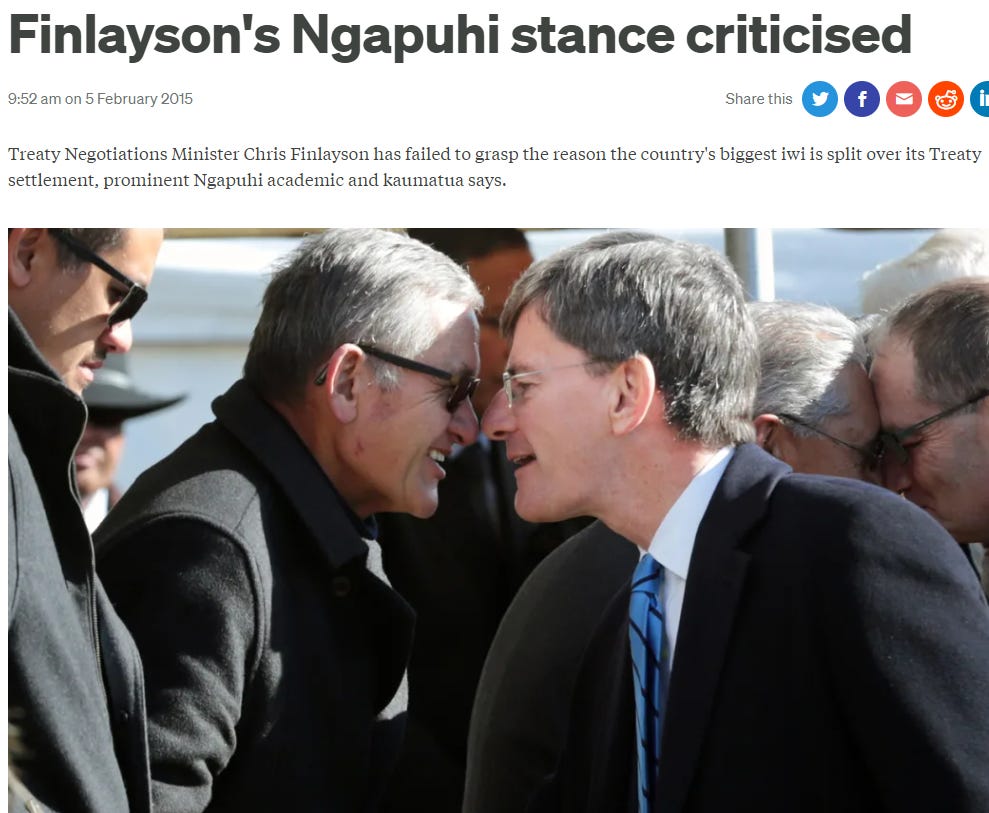
Māori land confiscations and unconscionable deals must’ve had a material adverse downstream effect on modern average Māori wealth. The fact that the populous Ngapuhi tribe occupies impecunious Northland and hasn’t achieved a settlement with the Crown no doubt skews Māori poverty figures downwards.
The effect of Māori movement to cities is complex and may’ve been adverse overall. And I suspect the neo-liberal economic reforms ushered in by Labour in the 1980s (and continued by National) had a disproportionate detrimental effect on Māori. Perhaps the welfare state – by enabling the fracture of the tradition Māori extended family and creating intergenerational welfare dependency - hasn’t, on balance, helped.
Most Māori have not benefited economically from Treaty settlements. In other words, there’s been no trickle down. Treaty settlement money has been captured and squandered by Māori elites.
I don’t believe modern Māori are generally lazier or less inclined to commercial activity than non-Māori. But perhaps Māori are culturally less inclined towards grasping Western materialism.
Being consistently told, and coming to believe, that you have no economic hope because your ancestors were colonized could well stifle your economic endeavors and prospects.
The catastrophic economic mismanagement of the last Labour Government and its administration (particularly Adrian Orr’s Reserve Bank) has had disproportionate adverse economic effect on ordinary Māori. (“Ordinary Māori” is arguably tautological; “māori” means ordinary.)
Moving healthily along…
Health
The average life expectancy for a Māori man is about 74 years; 77 for a Māori woman. The average life expectancy for a non-Māori New Zealand man is about 81 years; 84 for a non-Māori woman.
Of course, even though death is the ultimate sign of bad health, longevity is no measure of good health. One can linger on for years, in dreadful health. Earlier death often spares the deceased the indignities of old age. Nonetheless, lower average life expectancy for Māori tends to indicate that, overall, Māori are less healthy than non-Māori.

Woke’s reason for relatively bad Māori health stats is of course systemic racism. Which is not a reason at all. It’s simply a restatement of the reality that people with a Māori ancestor tend to live shorter lives. Ask yourself, what could it possibly be about a health system that it causes worst health outcomes for people who happen to have any Māori ancestry? White colored hospital walls? Māori, contrary to the Woke orthodoxy, are not actually a different species of human.
Here's what Artificial Intelligence says in response to the question “Why are Māori overrepresented in negative health stats?”:
Māori are overrepresented in negative health statistics due to a combination of historical, social, and systemic factors:
1. Colonization and Historical Trauma: The legacy of colonization has had long-lasting impacts on Māori communities, including loss of land, culture, and autonomy. This historical trauma contributes to ongoing social and health disparities.
2. Socioeconomic Disadvantage: Māori are more likely to experience poverty, lower educational attainment, and unemployment.
3. Racism and Discrimination: Māori often face discrimination within the healthcare system, leading to inequitable access to services and poorer quality of care. This systemic racism exacerbates health disparities.
4. Chronic Diseases: Māori have higher rates of chronic diseases such as diabetes, cardiovascular disease, and asthma. These conditions are influenced by both genetic and environmental factors.
Addressing these disparities requires a multifaceted approach, including improving access to culturally appropriate healthcare, addressing socioeconomic inequalities, and tackling systemic racism.
Has Artificial Intelligence made you any the wiser about Māori health?

Māori health is characterized by significant mumbo jumbo and pseudo intellectualism. Consider the excerpt below from a 2019 article in medical journal, The Lancet. What sort of peer-review could this “research” possibly have received? Each of the authors are from a University of Canterbury “laboratory”, Te Taiwhenua o te Hauora | GeoHealth Laboratory (another outfit that applies a trendy Woke abomination of real “geography”).
“Although redistribution, decolonisation, and power sharing remain aspirational for Indigenous people, the field of public health can make positive contributions to the dialogue on health inequities, via reorientation of systemic and health determinants, and via encouragement of equity-focused policies and practices, both nationally and internationally.”
Here are my hot reckons on factors that might contribute to Māori living shorter lives than non-Māori:
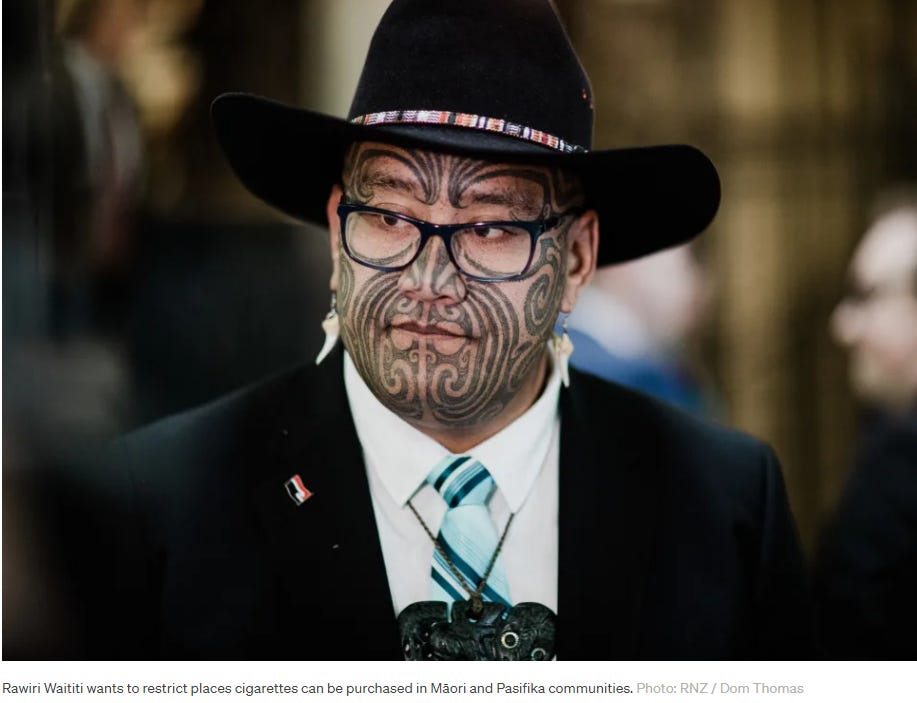
A higher proportion of Māori than non-Māori smoke tobacco. And tobacco, while a time-honored neural stimulant, is bad for one’s health, especially if smoked in large quantities. (Māori Party co-leader Rawiri Waititi enjoys cigarettes but blames colonization and systemic racism for higher rates of smoking among Māori. He has also enjoyed a State-funded stomach stapling operation, which for a while cured his obesity, but hasn’t credited colonization for his operation.)
Māori are less inclined to use the public health system. This is partly because they’re told, by Māori activists and a certain cadre of Pakeha Wokesters, to be suspicious of Western medicine.
Being constantly told they’re the innocent victims of colonization and racism has robbed many Māori of any sense of agency when it comes to their health (and their lives in general). This cult of victimhood has made many Māori feel despondent and fatalistic. Feeling victimized aint good for anyone’s health.
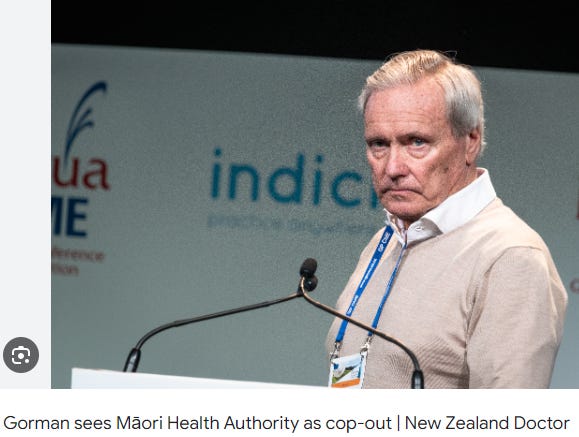
Māori have suffered from a central Government, command-and-control approach to Māori health - as opposed to an on-the-ground, by-Māori-for-Māori, approach that would be consistent with Article II of the Treaty of Waitangi (Tino Rangatiratanga). This bureaucratic paternalism has most recently manifested itself in the now-disbanded separatist Māori Health Authority (Te Aka Whai Ora). Former chair of Health New Zealand (Te Whatu Ora) Rob Campbell opposed the abolition of the Māori Health Authority. But Campbell is a charlatan grifter with absolutely no public health expertise. On the other hand, probably New Zealand’s foremost public health exert, Emeritus Profession Des Gorman, who is Māori (Ngāti Kuri and Ngāpuhi), agrees with the decision to abolish the Māori Health Authority. You can hear Gorman here…
Māori are statistically more likely not to turn up to doctor’s appointments and may, on average, simply be more cavalier about their health. Māori, certainly young Māori men, undoubtedly have more bad accidents on average that non-Māori. None of this, of course, is anyone else’s fault, individually or collectively.
Crime & Punishment
There’s no doubt Māori are over-represented in prison. Māori make up about 17% of New Zealand’s population, but about a half (50%) of the nation’s prison population.
Even after adjusting for the fact that the prison population is younger on average than the general population and Māori are, on average, younger than non-Māori, Māori are still over-represented in prison. Likewise, even taking into account that the prison population is on average poorer and less educated that the general population, and equalizing for poverty and education, Māori are still over-represented in prison.
The main, albeit superficial, reason for Māori over-representation in prison is that Māori are incontrovertibly committing more crimes for which the perpetrator is liable to be imprisoned. Exactly why Māori on average commit more imprisonable crimes case is…anyone’s guess.
Again, here’s what I reckon…
Māori traditional society was violent and Māori over-representation in violent crime (for which one often ends up in the clink) could be a modern echo of that cultural norm. Māori are still inclined to glorify violence and those who perpetrate it. The sadistic killer Te Rauparaha has a Porirua sports stadium named after him. If Te Rauparaha had behaved now how he behaved back then, he’d have spent his whole adult life in jail.
Māori may simply be less inclined to comply with the law. After all, while traditional Māori society had cultural norms (which varied between tribes), there were no laws.
What are the answers?
The Māori predicament is certainly not helped by the fact that Māori breed young, and lots. But the State can’t realistically do anything about that.
Although the answers to why Māori are over-represented in poverty, poor health and criminality are not entirely clear, perhaps the solution is not to fixate on the backward-looking “why”. Instead, perhaps New Zealand should concentrate on augmenting future opportunities for Māori to improve their lives.
The former Labour Government deliberately sought to denude New Zealanders, including Māori, of any sense of personal agency, and to make us all supplicant dependents on the State.
Perhaps the general answers to Māori maladies are the same as for all New Zealanders; to rekindle a spirit of personal responsibility, autonomy and self-sovereignty.
A very good summation. What is not covered is infant mortality, and its cause - and its ongoing inter-generational effect on adults may be very significant. Anecdotally, it also seems to be the case that Maori women predominate in the unmarried statistics and have children with multiple partners. Again, cause and effect.
What an excellent article John. So much of what you have mentioned in regard to the crime stats for maori I believe start at a young age in the home. Although I believe maori women truly cherish their children it is the macho attitude of the men towards their women and children that is the problem.
I have witnessed first hand how maori fathers/men treat their sons in an effort to bring them up"tough." It is an utter disgrace and I believe a root cause of a lot of the problems, considering most maori women are subjugated to their menfolk. Somehow this cycle needs to be broken.